Sep 22, 2026Sourcing Guide
Low MOQ Custom Bike Helmets: Start a Private-Label Line at 300 Pieces
300 pieces per model can carry your colors, logo and packaging. Here is what a low-MOQ helmet run includes, what it cannot buy, and how to prepare a brief that gets you a real quote.
Can you start a private-label bike helmet line with only 300 pieces? Yes — 300 pieces per model is enough for custom colors, your logo, and your own packaging. It is also a minimum order quantity (MOQ) many factories never quote, because it is too small for their production schedule.
This guide is for bike shops adding a house brand, online sellers moving up from generic stock, and young brands testing a first design in South America, Southeast Asia, the Middle East, or Europe. It is not for single-piece retail purchases or projects that need a brand-new mold.
By the end, you will have a one-page customization brief — market, model, quantity, colors, logo, packaging — ready to send to any supplier. Sending it commits you to nothing: no deposit, no order, just answers. Certification documents are available for specific models and markets; we do not claim every model is certified.
Why Factory Minimums Sit Far Above Your Run Size — and What Changes at 300
- You are the person making this call: the shop owner, the store manager, or the founder whose name is on the label. No one upstream will make the private-label decision for you, and the first real test is not design or budget — it is whether a factory will even talk to you.
- Usually something concrete starts this: a new season, a new listing, or a first trade show. You want helmets on the shelf or live in your store by next spring, so you send the same inquiry to five or ten factories and wait. That first round of replies is where many first-time buyers get stuck.
- The replies come back with minimums far above your run size, and no explanation of what those numbers actually pay for. Nobody tells you which parts of customization are driven by mold cost, tooling, and print setup, and which parts are simply a production scheduling choice. Without that breakdown, you cannot tell whether 300 pieces is genuinely impossible or just inconvenient for the factory.
- So many buyers do one of two things: they keep switching suppliers, re-explaining the same project to a new salesperson every two weeks, or they over-order to reach the minimum — hundreds or thousands of pieces of a design nobody has tested yet.
- Both paths can cost money in different ways. The first may delay your launch past the season you were aiming for; the second can tie up your cash in slow-moving inventory and turn your first product decision into a storage problem.
- The decision this page helps you make is a simple one: find out whether your product can work as a 300-piece custom run — and if it can, leave with a brief that gets you real answers instead of a minimum-order number.
What Your 300-Piece Run Can Actually Include
High minimums are real — they just price a different kind of order than yours. A large minimum can bundle in new tooling or new components. What you want is the layer above the existing product: your colors, your brand, and your packaging on a model that already exists. Here is what that layer includes at 300 pieces per model.
Layer | What it means at 300 pieces per model |
|---|---|
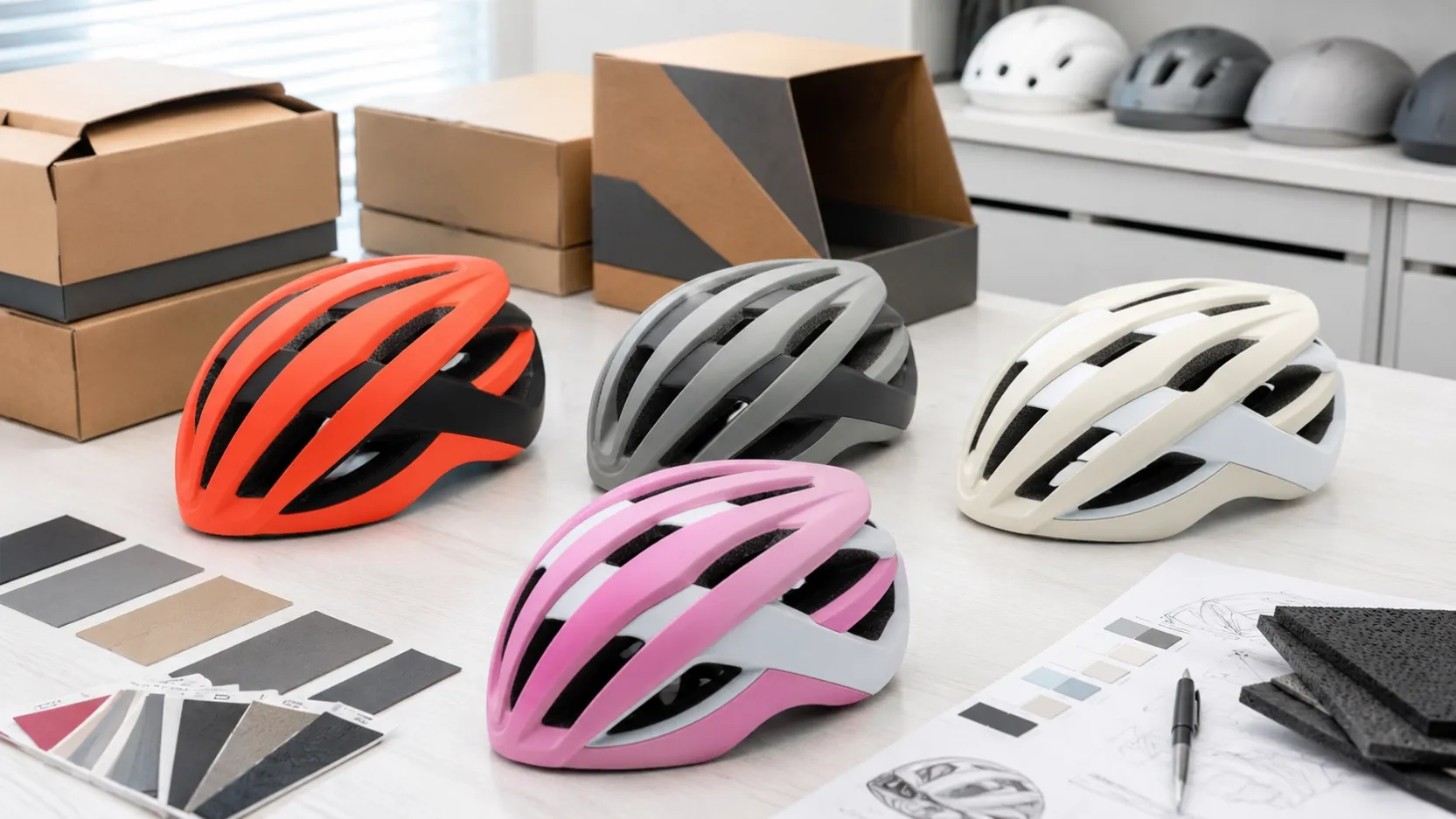
Colors and colorways | Your chosen combinations from the factory's palette: solid, two-tone, matte or gloss. |
Logo | Printed or decal logo on the shell, plus strap tags and interior labels. |
Packaging | Your own box, hangtag, and instruction card carrying your brand. |
Components | Select among visors, rear lights, magnetic visors, padding colors, buckles, and sizes within the existing shell. |
Size mix | Split your run across S/M/L within one model, subject to the small per-size minimums we confirm with the factory for you. |
Model choice | Any current catalog model that is open for customization — you can check which helmet models are open for customization before you commit. |
Stock models are a separate, easier case: if you only need stock colors and stock packaging, quantities can be flexible — and for some models, stock on hand can shorten the wait.
Mold and structural changes are the one thing a 300-piece run cannot buy. A new shell shape, a new EPS liner geometry, or a newly tooled component is a separate development project with its own budget, timeline, and minimum order — ask for that conversation separately.
From Sample to Shipment: A Realistic Timeline
- Stock sample first. One stock model with no logo customization is free — you cover the freight. It is the fastest way to judge shell shape, weight, and finish in your own hands. If a model has stock, we will tell you.
- Customized sample. Once you pick a model and share logo files and colors, a customized sample takes 7–20 days depending on the model and how much changes.
- Production. After you confirm model, colors, logo, packaging, and size mix, your run is scheduled. Production takes 7–50 days depending on order size and complexity — a clean 300-piece run on a stock mold moves very differently from a multi-color custom batch. You can see how the OEM production process works step by step before you plan your dates.
- Inspection and packing. Inspection and packing are coordinated before shipment. Helmets ship in OPP bags by default, 12–30 pieces per carton, with carton weights around 6–9 kg — or packed for your own branded box if that is part of your order.
- Delivery. Export documents are prepared for your shipment, and we can coordinate delivery to your port or your forwarder.
Every date above is confirmed for your specific order in writing before production starts. None of it is a promise made on a webpage.
Certification, Honestly: What "CE / CPSC / SG Available" Really Means
Certification is available by model and market, not by default. There are two very different sentences in helmet sourcing: "this model can pass the test" and "this model has a current certificate." Suppliers mix them up all the time. Here is our version: specific models have been tested, and reports on file cover EN1078 (CE), 16 CFR 1203 (CPSC), ski helmet standards, and EU type examination for the relevant models. For Japan, SG-marked models are available the same way.
Before you order, confirm four things in writing: which standard, which model, which test house, and what date. A report that names a different model, or one that expired, protects no one — not your customers, not your brand. If you sell into more than one region, compare what EN1078 and CPSC testing require for your market before you lock your model list.
Working With a Sourcing Partner vs a Single Factory
We will say this plainly, because you will hear it from others anyway: FONYON is a sourcing and export company based in Shenzhen, not a factory. We coordinate three partner helmet factories and stay accountable for your order from sample to shipment. A sourcing partner earns its margin by solving problems a single factory would simply decline.
A single factory gives you one catalog and one production schedule. We compare across three production lines, so when a model is busy, a color is short, or your packaging changes, your order is not stuck behind someone else's. That also means your 300-piece request is priced against our combined order volume, not as a one-off — which is how a small run gets closer to the pricing that larger buyers normally see.
There are two practical differences you feel every week. First, time zones: we sit in the same time zone as the factories, so a question you send before you close on Friday is being handled on the factory floor the same day, not two days and three emails later. Second, language: we manage the details in Chinese, so things like packaging film thickness, liner color, or a strap change do not get lost in translation between you and the line.
If you need a packaging change or an urgent delivery, we can switch production lines within 24 hours. Send a question any time — expect an answer within one business day.
When 300 Pieces Is Not the Right Fit
If your project needs a new mold, 300 pieces will not buy it — and a supplier who says otherwise is selling you a delay. Beyond that, be honest with yourself about these cases:
- You want a completely new helmet shape or a structural redesign. That is a separate tooling project with its own minimum order.
- You need one or two helmets for personal use. Buy a stock model retail and test the market that way.
- Your target market requires a certification this model has not been tested for, and your launch date leaves no time for testing.
- Your only criterion is the lowest possible unit price. A stock model without customization will always beat a custom run at this quantity.
Walking away from the wrong project is cheaper than fixing it later. If any of these sound like you, tell us anyway — we will point you to the version of your plan that actually works.
Your Next Step: The One-Page Customization Brief
Fill in the brief once, and stop re-explaining your project to every supplier. Ten minutes here replaces weeks of back-and-forth. Copy the questions below, answer them in a document, and send it as one email.
Question | Your answer |
|---|---|
Target market and certification needed | e.g., EU (EN1078) / US (CPSC) / Japan (SG) |
Model or category | e.g., urban commuter, MTB, kids, ski |
Quantity per model | 300+ for custom work; stock models can be flexible |
Size mix | e.g., 100 S / 120 M / 80 L |
Colorways | how many, and any reference colors |
Logo files | vector (AI/PDF) preferred; single-color or full-color |
Packaging | polybag, branded box, hangtag — or "same as sample" |
Target cost per unit | your budget or target landed cost |
Target delivery window | when you need the goods on shelf |
Anything else that matters | lights, visors, ear pads, special requirements |
Send it to phanny@fonyonhelmets.com — Phanny, our sales lead, answers within one business day with model options, sample terms, and a quote. If you only have one question right now, ask it on WhatsApp at +86 151 1228 2294. And if email is not workable for you, the same brief works as a document on WhatsApp.
Your brief is used only to prepare your quote and sample options, kept for our business correspondence, and deleted on request — just say so in the same email. Only your project details are needed: no payment information, and nothing you would not share with a supplier you are evaluating.
If your project fits, the next things you will want to read are what private-label importers prepare before a first order and how our OEM and customization process works. Either way, you will know within a day whether a 300-piece run is your right first step.